communicating

Camry The Crow - A Real Friend

Camry Crow and Darren By Belinda Elbourn

When Darren and I lived just west of Ceduna in South Australia we were very lucky to have shared our lives with 2 very special crows.

The first one to arrive on our door step was Camry, at first Camry was very shy little bird.

But after a day or two soon became a very demanding, cheeky loud little bird.

He spent the first couple of months in our enclosed back veranda.

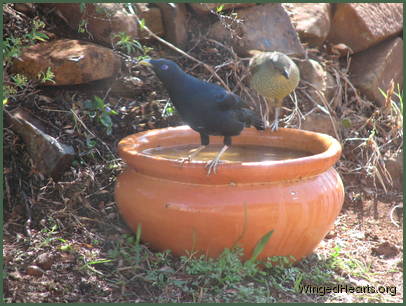
As we had a huge enclosed fruit tree cadge (Darren and Camry are standing in it in the top photo) we thought it would be best for him to live out there, plenty of room to fly and hide.

Camry soon became very close to Darren, if was to go out to the cadge to feed him he would hide in the orange tree and would not come out.

  read more »

Wild Bird Shelly Magpie Walks Into The Cage On Request

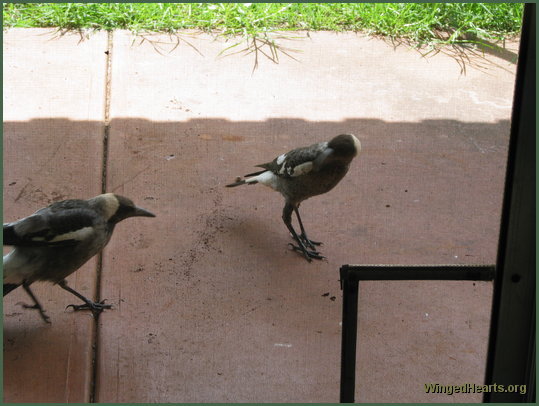
Shelly magpie (left with injured wing) and sister Nelly magpie

Juvi magpies - Shelly (left) with sister Nelly at our back door.


Will a wild bird (never handled or hand fed) walk into a cage just because you ask her to?

Juvi magpie Shelly injured herself on the day of the terrible storms resulting in the inland tsunami in Toowoomba and the Lockyer valley. She didn't come down with her family for two days. Due to the heavy rains we couldn't go out into the neighbouring paddocks looking for her either. We thought she may have met a tragic end in the storms, but when the rains stopped briefly on the third day Ron went scouting and found her sitting still in a paddock. Relieved to find her alive, Ron and I would go out to the fields to feed her when we could.  A few days later she started to walk but after 3 weeks she still could not fly.  She could only climb up tree trunks by hopping along along fallen branches that were still leaning against them as in the picture below. 
 read more »

How Do Parakeets Communicate?

I recently found this very interesting article by Parrot Intelligence Researcher and Communicator Ryan B Reynolds.

In his paper Reynolds says that:

"If you have ever seen a flock of parakeets, you may have noticed how they all seem to be chirping and vocalizing at once. To most of us, this just seems like a whole lot of birds making a bunch of noise. Most people could not imagine how they could possibly be communicating with each other or understanding what each other is saying. Many people  usually regard birds as non-sentient and unable to communicate. Others have determined that they may be able communicate some, but only at very limited levels. However, this research has shown that they are more than likely communicating at extremely high levels and each and every one of them understands what the other is saying. It also suggests that their advanced communication abilities not only allow them to understand every bird in the flock, but they are able to send and receive information simultaneously. They even take this one step further and are able to communicate and understand more than one bird at the same time using different dialects. So this is a very complex form of communication, which allows them to learn the human language very quickly in a domesticated environment. My studies have also shown, under certain conditions, they can talk and understand what they are saying many times faster than humans are capable of learning. This was evident in at least four budgies in our group that learned to speak in sophisticated conversational language before they were six months old."

I think Reynolds research is of vital importance and corroborates what we know about the birds in our back yard.

Click here to read the rest of Reynolds article. read more »

Communicating With Wild Birds

Articles and Stories on How To Communicate With and Understand Wild Birds

 rainbow lorikeet on grevillea bush

  read more »

More on:

Breaking Through The Communication Barrier With Birds

by Francesca Doria (British Columbia)
 
 
In spite of all our New Year’s wishes, 2008 hadn’t begun well for my sister and I. Our Mum was bone-marrow transplanted and had been through a hard time, and our cat Émile, that had shared half of our lives with his endless care and reassuring love, was about to die of kidney failure. He had held out to help our mother and the two of us, but now he was wearing out, silently fading away. At the time our mother’s house had been restored, my sister and I had lived in until the inner works had started, so we had to move to our own flat where our mum already dwelt.
 
While I was staying with our mother and Émile, my sister Paola got back to the big house to tidy up and put in order everything. She immediately called me, informing that there was a jay she was feeding every day on my window sill and a pair of magpies building their nest on the top of our secular magnolia tree.
 
At first I was thrilled: I had always loved those elegant, intelligent, funny and noisy birds, and that news had surpassed my wish. But being in anxious state of mind, I nearly forgot both magpies and the friendly jay, until I came back home along with our mum, Émile and our other four cats.
 
The magpies were still at work: the male brought branches and other items, the female observed/examined them carefully, tried them out, sometimes discharged them, and he flew back and forth trying to find the best things to fit.
 
 
magpie nest in tree


The jay was still coming, curiously watching the new incomers. There also was a couple of large hooded crows, that were the undisputed owners of that territory, from a bird’s point of view.
 
We came back home on 4th March 2008: Émile made a huge effort to visit once again all the rooms of the house; although many things had changed dramatically (my sister’s room had a different entrance, one of the bathrooms had been rebuilt and much more) he recognized his house, blessed it and stood with us quietly and warmly as he had always done.
 
On 16th March he was put to sleep: until that day the sky had been beautifully crystalline and blue, the sun had shone bright, the moon at night was big and white in a starry sky, the sea was stunningly navy blue and glittering with sun sparkling, there were breathtaking sunsets. But that day the sky grew dark, and heavy drops of rain began to fall. They got heavier and heavier, like a machine gun; although I was dazed with grief, I couldn’t help thinking of the poor birds outside, especially the pair of magpies, whose nest was under that torrential rain. The female sat on her eggs and never moved; the male brought her food.
 
 read more »

Birds can communicate without words

Since meeting Maggie Magpie and being introduced by him to magpie families and to many other species of birds, Gitie and I have become increasingly and profoundly impressed by their high intelligence and, yes, wisdom.

Maggie bright and cheerful
Maggie Magpie

I find it sad that scientists often automatically assume that only humans "think" or are "conscious". I have never quite worked out what they mean by that, because it doesn't take much looking to see intelligence in a great many other animals. Ask a cat owner!

The way contemporary animal behaviour scientists see the world is, in my opinion, profoundly unscientific. Their reasoning seems to go like this: animals do not think, they merely respond to instincts; they don't have feelings, they just react as their instinctive programming determines; humans, on the other hand, have a qualitatively different kind of intelligence and language and can construct uniquely 'human' realities like love, loyalty, and ethics, and can invent institutions like property ownership and inheritance. read more »

Wild Birds Love 'The Big Eye'

female cuckooThe first time a bird sees a camera, he/she may feel a bit unsure of the big thing we place next to our eyes that also makes a clicking sound.  But in no time at all, they realise that the sound poses no danger to them. Once they become comfortable with the sound, they feel quite amused by our fondness for pointing this object towards them.

We use a Cannon S5 with a 1.5 teleconverter lens which is a reasonable sized equipment. To the bird it looks like we have added a big round black giant sized eye to our eye.

The birds have no idea what the camera really does for us, but that doesn't stop them from appreciating many things about it, in their classic style of observing our actions. read more »

Listen With Your Eyes

scaly-breasted lorikeet In order to understand birds, one has to pay attention with both ones ears and eyes.  In other words we need to hear  the sounds they are making while also following their actions. I call this 'Listening With Your Eyes'.

Birds love chattering and sharing the days news with each other.  Every bird species has its own language. The different species don't have much difficulty following each other.  The birds also have a range of soft almost inaudible 'mm', 'bb' type sounds and a lot of their communication is also non-verbal. read more »

7 Tips to Get To Know Your Wild Birds - Part 2


This is one of the first pictures I took of our birds back in 2001 with a film camera. (Any one remember those things that had to be handled carefully and in the dark?)

Molly magpie teaching Maggie magpie and Cindy magpie to sing

Here sitting on an old gum tree is Molly the mother magpie teaching juvis Maggie and Cindy to sing.  They had the most brilliant voices and loved singing at top volume.  This was during my early days of friendship with them. 

In today's post we will explore tips 4-7 of getting to know your wild birds. read more »

7 Tips to Get To Know Your Wild Birds - Part 1

Vicky magpie with visiting rainbow lorikeets  By now you will have a few friends whom you recognise and call by name. The next stage is to get o know more about your birds. 

There are seven main points that you can follow to further develop your relationship with your new wild bird friends.  These are:

1. Make Time For Regular Interaction

2. Learn More About The Species

3. Gain Insight's Into Your Individual Bird Friends

4. Listen for Cues

5. Notice Changes In their Behaviour

6. Keep a Daily Journal

7. Look for Wider Patterns and Stories read more »

Theme provided by Danetsoft under GPL license from Danang Probo Sayekti