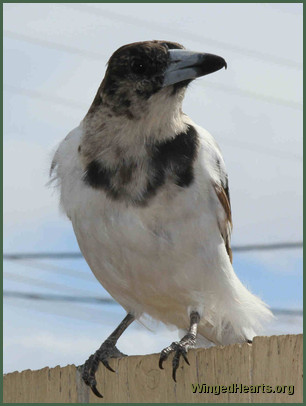
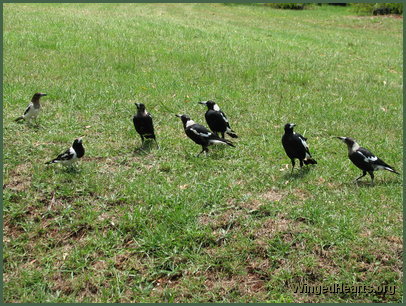
Magpie

Australian Magpie

How to Speak Magpie - 1

One of the things that has amazed me, and amazed me over and over again, is the intelligence of Australian Magpies. They know how to talk to us, but do we know how to understand what they are saying? I have learned a few "phrases" in magpie language since meeting our Maggie Magpie, and I want to tell you one today that I learned from Maggie's wife Vicky.

I call this the J-phrase. Vicky has used it at least twice with Gitie and me. She might have used it even more than that, but we perhaps didn't notice and Vicky would probably have thought how dense these humans can be at times.

Here it is: Your magpie friend flies towards you, then flies at a very slow speed in a half-circle around you, about three metres away; then she stops: read more »

Breaking Through The Communication Barrier With Birds

by Francesca Doria (British Columbia)
 
 
In spite of all our New Year’s wishes, 2008 hadn’t begun well for my sister and I. Our Mum was bone-marrow transplanted and had been through a hard time, and our cat Émile, that had shared half of our lives with his endless care and reassuring love, was about to die of kidney failure. He had held out to help our mother and the two of us, but now he was wearing out, silently fading away. At the time our mother’s house had been restored, my sister and I had lived in until the inner works had started, so we had to move to our own flat where our mum already dwelt.
 
While I was staying with our mother and Émile, my sister Paola got back to the big house to tidy up and put in order everything. She immediately called me, informing that there was a jay she was feeding every day on my window sill and a pair of magpies building their nest on the top of our secular magnolia tree.
 
At first I was thrilled: I had always loved those elegant, intelligent, funny and noisy birds, and that news had surpassed my wish. But being in anxious state of mind, I nearly forgot both magpies and the friendly jay, until I came back home along with our mum, Émile and our other four cats.
 
The magpies were still at work: the male brought branches and other items, the female observed/examined them carefully, tried them out, sometimes discharged them, and he flew back and forth trying to find the best things to fit.
 
 
magpie nest in tree


The jay was still coming, curiously watching the new incomers. There also was a couple of large hooded crows, that were the undisputed owners of that territory, from a bird’s point of view.
 
We came back home on 4th March 2008: Émile made a huge effort to visit once again all the rooms of the house; although many things had changed dramatically (my sister’s room had a different entrance, one of the bathrooms had been rebuilt and much more) he recognized his house, blessed it and stood with us quietly and warmly as he had always done.
 
On 16th March he was put to sleep: until that day the sky had been beautifully crystalline and blue, the sun had shone bright, the moon at night was big and white in a starry sky, the sea was stunningly navy blue and glittering with sun sparkling, there were breathtaking sunsets. But that day the sky grew dark, and heavy drops of rain began to fall. They got heavier and heavier, like a machine gun; although I was dazed with grief, I couldn’t help thinking of the poor birds outside, especially the pair of magpies, whose nest was under that torrential rain. The female sat on her eggs and never moved; the male brought her food.
 
 read more »

Magpie Inheritance

Maggie Magpie and family with butcherbird friends
Maggie magpie and Butch butcherbird families

Until we met our magpies I had never really thought about animals having complex social systems. It’s pretty easy to think of animals as “dumb animals”! But our Maggie, sadly no longer with us, changed all that. By ‘adopting’ us into his family and introducing us to so many new friends of many bird species, Maggie opened a new world to us. All around us, birds (and, as stories from others show, other animals too) are conducting complex friendships, negotiations, and deals; they make promises, work to find good ‘positions’ in the world for their kids, and much more.

We humans get a bit uneasy when we discover we aren’t quite as far advanced beyond other animals as we like to think we are; laws of inheritance are a case in point. Surely no other animal has inheritance laws?

Well, there are clearly defined magpie inheritance laws. The countryside around our house is divided up in various ways by the various species. Magpies have one ‘map’ of the territory, on which they define the boundaries between their lands. The two species of butcherbirds here, pied and grey, share a single map between them. In other words, the magpies ignore the butcherbirds sharing their territories and vice versa, but the pied butcherbirds and the grey butcherbirds very much do take notice of each other and refuse to allow the other species into their zone. The butcherbird system has its own complexities, which I haven’t completely worked out, but I think I can tell you some details about magpie inheritance laws that might help you make sense of magpie activities around your place when a magpie dies. read more »

Birds can communicate without words

Since meeting Maggie Magpie and being introduced by him to magpie families and to many other species of birds, Gitie and I have become increasingly and profoundly impressed by their high intelligence and, yes, wisdom.

Maggie bright and cheerful
Maggie Magpie

I find it sad that scientists often automatically assume that only humans "think" or are "conscious". I have never quite worked out what they mean by that, because it doesn't take much looking to see intelligence in a great many other animals. Ask a cat owner!

The way contemporary animal behaviour scientists see the world is, in my opinion, profoundly unscientific. Their reasoning seems to go like this: animals do not think, they merely respond to instincts; they don't have feelings, they just react as their instinctive programming determines; humans, on the other hand, have a qualitatively different kind of intelligence and language and can construct uniquely 'human' realities like love, loyalty, and ethics, and can invent institutions like property ownership and inheritance. read more »

Vicky's sitting on her nest

Vicky greets us when we pay a visitYesterday Gitie and I went to see how Vicky and Bertie are doing this year on the nesting front. Although Vicky's nest is in line with our breakfast room, it is distant and we have not been able to set up the telescope this year. So imagine our delight when we found Vicky sitting proudly on the nest. The nest is in a tricky spot, so Gitie stayed by the road while I went through the paddock to the nesting tree. This is the tree that Vicky and Maggie purchased from a crow some years ago, giving the crow their old tree and nest in return, as well as rights to get food from their human friends (us) for a year). The crow made Vicky's old nest bigger and stronger, while Vicky lined the crow's nest with lots of soft material. read more »

The Magpie Winter Season

Our birds have had a strange winter to deal with: overcast most days instead of sunny, cold days, but some warmer nights as the clouds keep the heat in.

Our magpie family, Vicky (the queen), Bertie (her consort - alpha male but her subordinate!), Vicky's adult daughter Mindy and youthful daughter Kenny, have fared well, but with a fly in the ointment: Mindy's twin brother Monty was told to leave when Bertie moved in, but he has gone across the gully and formed a group with three others. One is a daughter (Louie) of our other magpie family, Billy and Polly, but two more seem to be newcomers. We were feeding Monty when he was alone, but since his foursome has been formed, they think they can muscle in on the breeding pair's feeding ground - which is against magpie rules, of course, but his own mother is not keen on sending him packing, and so Bertie and Mindy have to do all the work of repelling Monty's gang, which is proving tough for Bertie. Luckily Bertie is an amazingly strong bird, but we have had to add our support to his side of the dispute and tell Monty we can't feed his gang any more. read more »

Babblers and Magpies - A Friend In Need Is A Friend Indeed

babblers frolicking Babblers although larger than noisy-miners are still small, gentle birds that can be easily preyed upon by hawks and other predators.  They stay in their family groups, constantly moving and flitting about so as to confuse any hungry eyes watching them with  the wrong intentions. They are generally very shy and quite nervous birds and don't project the immense self-confidence that we've seen in quails for instance.

They like hovering in muddy patches, or near gravel, stone, logs and barks looking for insects.

We noticed their friendship with the magpies soon after we became friends with Maggie and his sisters Cindy and Tammie. 

  read more »

Inter-species Friendships in Birds

Maggie magpie and Minnie Noisy Miner best friends

 We've been observing the wild birds who live freely in the trees around our home for ten years.  Many of them are our friends. We know them by name, shape, looks and habits.  They all know their names and each others' names.  They call the one we ask for, often going into the valley to find them and bring them back.

Many naturalists say that the different species don't interact with each other.  But our experience and observations tell us otherwise.  The birds have amazing friendships with birds from other species, even other animals and certainly with us humans.  They are  read more »

If I Were A Duck....(and not just a magpie)!

juvenile magpie Monty having a bathAfter the tragic loss of three gorgeous chicks (and possibly more) Maggie and Vicky were happy to be blessed with Monty and Mindy from Vicky's second clutch in 2007. Sophie loved the pair dearly, they help her heal from her loss. Wendy was happy to have two younger playmates - but was a bit overwhelmed by them at times.  read more »

Rescuing Baby Birds

So you've found a lone baby bird... Now what?

Quite simply, a wild animal's chance of survival is greatly increased when left in its natural environment.    Having said that, what about the 25% of babies that are orphans?

When you find a baby bird, before making any decision to intervene, the first thing you have to do is decide which of the following situations we're dealing with:

Read more in the Special Edition of Wild Bird Talking - Out  Now.

Just enter your details in the box in  left hand column and receive your copy at no charge.   read more »

Theme provided by Danetsoft under GPL license from Danang Probo Sayekti