Submitted by Gitie on 11 January, 2013 - 09:27
by Yvonne Morrin (Bats Qld)
 Now I have finished my course of vaccinations, I have finally started rescuing. My first bat was entangled in fishing line with a fishing hook embedded in her side – the constriction injury was severe, and she was euthanized.
The second had been up a food tree for a week without flying away, and appeared to have a wing injury. He could clamber around the tree perfectly well, just out of reach of my pole! Finally I got him to the ground, and he began to crawl, his wing injury very apparent now. Unfortunately he was a euthanasia case too.

Submitted by Gitie on 18 August, 2012 - 20:47
By Lee McMichael from Bats Qld
On the way back from a work field trip in Gayndah we travelled via Esk where we noticed a gentleman peering up at the powerline on the main street looking distressed.
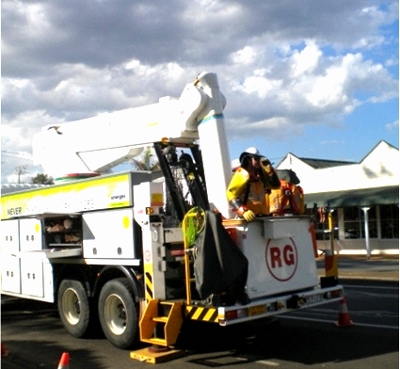
A tiny black flying fox pup was hanging on for life up there. We stood for quite a while trying to discern whether the little one was alive or dead. After about 10 minutes, a pair of binoculars and some reassuring chatter we saw a pair of little ears prick up. She was alive!
Submitted by Gitie on 16 July, 2012 - 07:57
Submitted by Gitie on 28 April, 2012 - 17:22
by Gabi Friebe from Long Grass Wildlife Refuge and Bats Qld
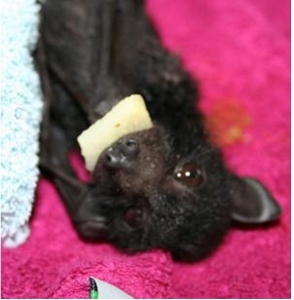
Tulip was an orphaned baby rescued from Esk. I got the call late afternoon and went to check. I saw the mother high up in a tree looking down and the baby was just hysterical. Seemed like a perfect reunite so I fed the baby, gave it a mumma roll tied to a branch where the mum could easily land and as I was on the way to Long Grass decided to leave the two to get together after dusk. The baby was calm by this stage and there was a helpful caller who would keep an eye on the situation who advised me that there was some altercation with dogs which is why they separated in the first place. 10pm I called to see if the mum was with bub. Sadly no and bub was screaming. Yes you guessed it back in the car for the trek to Esk to colect Tulip. Next day passing Esk on my way back to Batavia the mum was still up the tree fairly obviously injured by her altercation with the dogs and unable to fly. She had not moved. Such a sad situation but I was comforted slightly by knowing how pleased mum would be to not hear her baby screaming.
Submitted by Gitie on 6 October, 2011 - 15:36
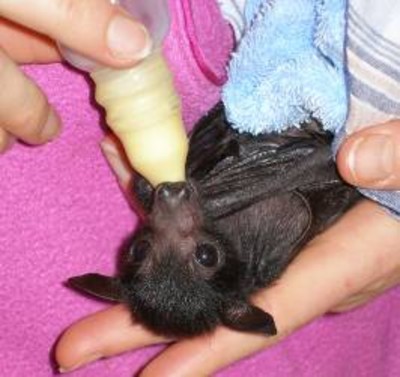 The recent outbreak of the potentially deadly hendra virus is a cause of great concern to horse breeders and farmers alike. According to the Department of Primary Industries, although the virus can be transmitted from horses to humans, found in bats, there is no evidence that it can be transmitted directly to humans. Flying foxes are critical to the environment and a protected species. Culling is not only cruel but also ineffective. (Ref: Flying Foxes and Hendra Virus; The role of flying foxes in Hendra virus)
There are many effective steps people can take in reducing the risk of horses and people getting infected. See:
Reducing the Risk of Hendra Infection in Horses
Reducing the Risk of Hendra Infection in People
Flying foxes are the only flying mammals and perform the quintessential task of pollinating and dispersing seeds of many native plants. Many trees especially those with white and green fruits rely only on flying foxes for pollination and dispersal of seeds. Losing our flying foxes would also mean losing a vast range of our native plants.
Flying foxes are also responsible for nutrient regeneration and nutrient cycling within the ecosystem, (Ref: Living With Wildlife) by providing large quantities of natural fertiliser across the landscape. They also create gaps in canopies enabling ground- dwelling plants to get more sunlight and rain.
Pages
 Now I have finished my course of vaccinations, I have finally started rescuing. My first bat was entangled in fishing line with a fishing hook embedded in her side – the constriction injury was severe, and she was euthanized.

 T
T