by Charmaine from Bats Qld
 A little over a year ago we were coming to terms with the death of over 50,000 bats in a heat stress event in SE Queensland. For most of the carers who attended the colonies on that day, this was their first experience with a heat stress event and most were left with feelings of frustration for their lack of knowledge on how to handle an event.
Moving on one year and although there has been no improvement in predictions of further heat stress conditions, there has been a vast improvement in the knowledge of most of the bat carer groups in how to work a heat stress event. In September 2014, Bats Qld organized a HSE workshop for all carers at the RSPCA Wacol. In the morning Linda Collins covered the basics of how to identify the different stages of a heat stress and what to do at each of the stages. In the afternoon, Tania Bishop presented a talk on how to treat heat stressed bats. The notes and manuals from these talks are available on http://www.longgrasssystems.com.au/heatstress.html.
It is my sincere hope that all bat care groups will incorporate this new knowledge in both their Rescue and Rehab and their Baby Care Manuals. Unfortunately, on the week-end of the workshop, further heat stress events occurred at the Caboolture colony and in Casino in northern NSW. Bats Qld members attended the Caboolture colony and orphans from both the Caboolture and Casino colonies were raised by Bats Qld members and are currently in crèche with Gabi at Woodford.
Recent reports from CSIRO and other climate change experts (http://www.garnautreview.org.au/index.htm) predict that the number of days hotter than 35 degrees will be dramatically increasing in Queensland which would suggest that heat stress events will become a norm rather than a rare occurrence. Flying foxes, especially Black Flying-Foxes, have not been exposed during their evolution to such high temperatures and the speed of this climate change means that there will probably be no time for evolutionary selection to favour bats that could handle increased temperatures. If this happens, bat care groups and their members will be called on to attend heat stress events on a regular basis. As a group, Bats Qld has made considerable progress towards preparedness for the next event. A core number of our members have been trained and will be able to supervise untrained volunteers at an event. We have stored at Woodford a number of backpack sprayers (which are the first line of action in an event) and water containers and we are currently working on the final draft of the Woodford Colony Plan. Although none of this will prevent a heat stress event, it should go a long way towards reducing the number of bat deaths on the day.
 A little over a year ago we were coming to terms with the death of over 50,000 bats in a heat stress event in SE Queensland. For most of the carers who attended the colonies on that day, this was their first experience with a heat stress event and most were left with feelings of frustration for their lack of knowledge on how to handle an event.
 Now I have finished my course of vaccinations, I have finally started rescuing. My first bat was entangled in fishing line with a fishing hook embedded in her side – the constriction injury was severe, and she was euthanized.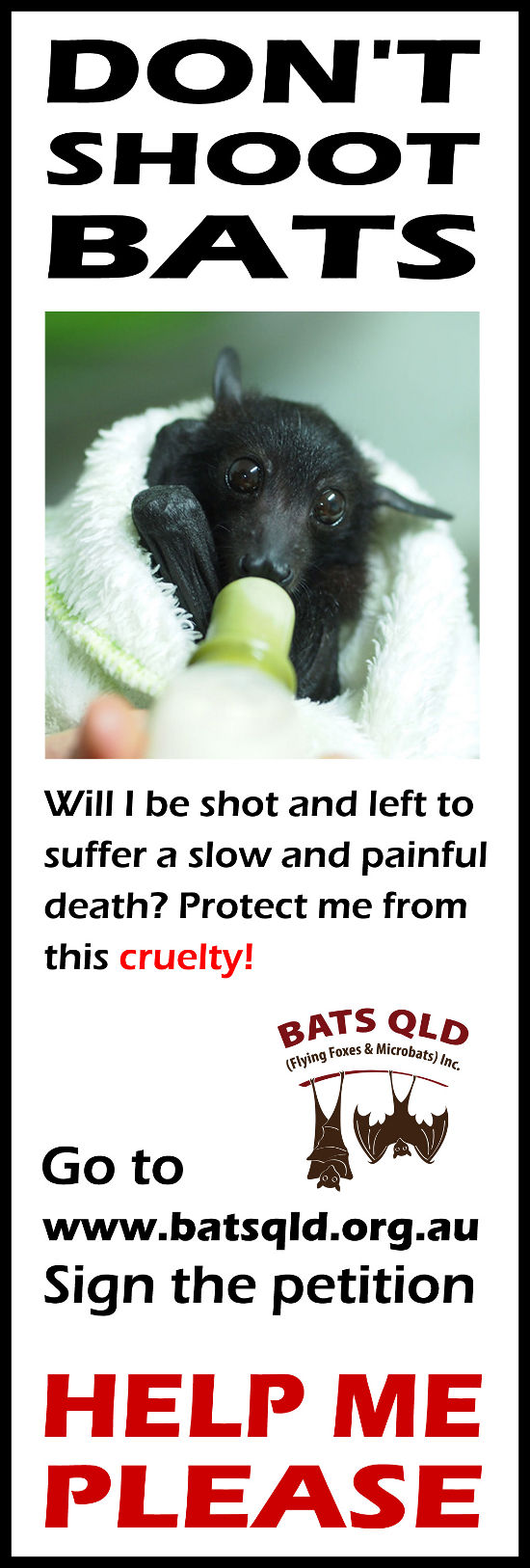
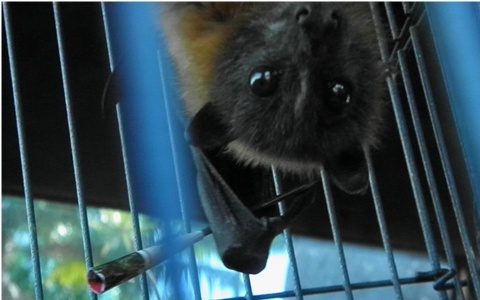 In recent months there has been a spate of deliberate acts of cruelty towards bats on the Gold Coast. These acts seem to have coincided with the sensationalised articles from our favourite fish wrap the Courier Mail and GC Bulletin. BatsQLD members were involved rescuing in two of these cases; Cherokee (Shot with a blow dart) and Peter Sterling (Shot with a .177 calibre air rifle).