Fungus Causes Deadly Bat Disease
News Release from USGS (26 October, 2011)
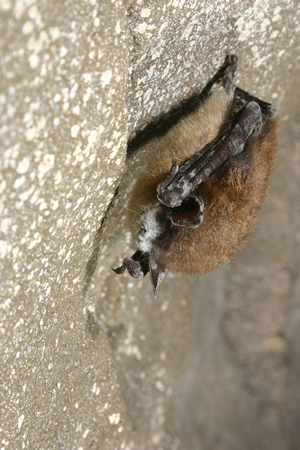
The appropriately named fungus Geomyces destructans is the cause of deadly white-nose syndrome (WNS) in bats, according to research published today in the journal Nature. The study by U.S. Geological Survey scientists and partners, conducted at the USGS National Wildlife Health Center in Madison, Wisc., provides the first direct evidence that the fungus G. destructans causes WNS, a rapidly spreading disease in North American bats.
|
Credit: Al Hicks, NY Dept. of Environmental Conservation |
“By identifying what causes WNS, this study will greatly enhance the ability of decision makers to develop management strategies to preserve vulnerable bat populations and the ecosystem services that they provide in the U.S. and Canada,” said Anne Kinsinger, USGS Associate Director of Ecosystems.
During the study, 100 percent of healthy little brown bats exposed to G. destructans while hibernating in captivity developed WNS. Additionally, the study demonstrated that G. destructans can be spread through contact between individual bats. “While our study confirmed that G. destructans is spread bat-to-bat, it is also important to note that virtually all pathogens, especially spore-producing fungi, are spread by multiple routes,” Blehert said. “This is the reason that in an effort to further control the spread of WNS, resource management agencies have implemented universal precautions, including limiting human access to sensitive environments occupied by bats, decontaminating equipment and clothing moved between these environments, and restricting the movement of equipment between sites
The appropriately named fungus Geomyces destructans is the cause of deadly white-nose syndrome (WNS) in bats, according to research published today in the journal Nature. The study by U.S. Geological Survey scientists and partners, conducted at the USGS National Wildlife Health Center in Madison, Wisc., provides the first direct evidence that the fungus G. destructans causes WNS, a rapidly spreading disease in North American bats.
“By identifying what causes WNS, this study will greatly enhance the ability of decision makers to develop management strategies to preserve vulnerable bat populations and the ecosystem services that they provide in the U.S. and Canada,” said Anne Kinsinger, USGS Associate Director of Ecosystems.
During the study, 100 percent of healthy little brown bats exposed to G. destructans while hibernating in captivity developed WNS. Additionally, the study demonstrated that G. destructans can be spread through contact between individual bats. “While our study confirmed that G. destructans is spread bat-to-bat, it is also important to note that virtually all pathogens, especially spore-producing fungi, are spread by multiple routes,” Blehert said. “This is the reason that in an effort to further control the spread of WNS, resource management agencies have implemented universal precautions, including limiting human access to sensitive environments occupied by bats, decontaminating equipment and clothing moved between these environments, and restricting the movement of equipment between sites
 del.icio.us
 Digg
Digg Facebook
 Google
 Google+
 LinkedIn
 MySpace
 Ping This!
 SlashDot
 StumbleUpon
 Twitter
 Yahoo
Yahoo