|
Thank you for subscribing to
the Wild
Bird
Talking Ezine.
You may forward this Ezine to
your friends. If you have received this issue from a friend and would
like to
receive your no-cost subscription please click
here.
|
|
 |
|
|
|
Back
to the Top |
|
|
From Maggie's Perch:~
Welcome to this issue of Wild Bird Talking
We have good news from Maggie's valley, as this season has brought more
regular rain turning the landscape green and giving the wildlife a
chance to recover from their earlier losses. Many magpie couples
have taken advantage of this good turn in fortune to rear a second
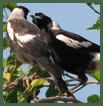
clutch. Maggie and Vicky now have two gorgeous twins Mindy and Monty. Butch and Cass our pied-butcherbirds have young Chucky who is the best singer in their family.
The birds always look for ways in which to give us something back.
We hadn't visited Vicky's nest for around a fortnight. The rains
had kept the ground quite wet and the weeds in the paddocks had
grown long and thorny, making it cumbersome to trek across them.
The plants in our yard were thriving and flowers
were blossoming after the prolonged drought. A break in the
rain gave me the opportunity to pull out the camera and point them at
the flowers, butterflies and shrubs, when Vicky flies over the
fields, settles on a branch overhead and talks to me in the softest,
sweetest whisper. I thought she wanted some food, but I was
mistaken. She wanted me to take the camera to her nest! It took
me a while to understand her message and when I did, sure enough,
there were two cute little heads peering out. Now Vicky has
no idea what a camera does for us. All she knows is that it is
important to us to take this funny object to her nest, place it near our
eye and point towards it. At best it is something that makes our
eye bigger and so better able to see. And she had something in
the nest to show us, and so she invited me at the first available
chance. This is not the first time that Vicky had shown us her understanding of what matters to us. Their ingenuity, depth of understanding and consideration never ceases to amaze us.
I would like to draw your attention to two matters of serious concern. the first is the plight of the pigeons
in cities and towns. Maggie Wright from Nature's Corner has brought
this to our attention and written extensively about it. Local
councils in many parts of the world have suddenly stopped the tradition
of feeding these birds, with the hope that they will go away. But the
birds have nowhere to go. Like people, they too live in their
'countries' or 'local areas' and in their case, and come flood or
famine they perish if neglected. The pigeons are literally
starving to death and this is no way for a civilised and kindly people
to treat its wild birds. Please read the blogs and help in any way you can
The second issue concerns the plight of the humble chicken, especially
in breeding and egg farms. A primary source of food and giver of
nutrition and life in many parts of the world, it is deeply saddening
that humans allow such an important bird to be so cruelly treated. The
International Humane Society is trying to raise awareness of the need
to end cruelty in this area. Authors Peter Singer and Jim
Mason have written about the truth behind the so called 'animal care'
labels in their groundbreaking book 'The Way We Eat - Why Our Food Choices Matter'.
When I came across the article by Theodosia Burr on 'Chickens
Know More Than We Think', it seemed only appropriate to include it in
this magazine where we celebrate the beauty of wild birds, so that we
can extend our thoughts and welfare to those creatures who are not
so fortunate.
Many thanks to our readers for their invaluable comments, suggestions and stories. We are keen to
hear from you and want to jointly develop a wider perspective.
Please send us your ideas and experiences via e-mail to editor@wingedhearts.org.
We hope you enjoy the selection of articles and stories and look
forward to your feedback and suggestions.
With
Warm Wishes,
From
Maggie
and me,
Gitie

PS:
We hope you liked the 13 page Australian Wild Birds Calender for 2008 from all of us
at WingedHearts.org.
The pages can be used individually, so if you would like to share
it with your friends they can still find it useful for the rest of the
year.
|
|
|
|
|
|
*****
Feature Article *****
|
Back
to the Top |
|
|
|
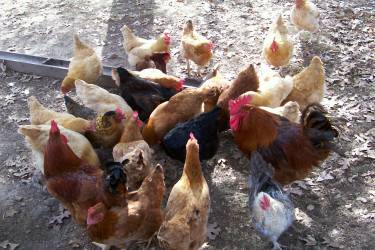
Chickens Know More Than We Think
Did you know that chickens worry about the future? I'm worried about
chickens worrying. But what worries me the most is that most people do
not worry about chickens at all.
A
recent sobering sight on the freeway brought the truth home to me. I
noticed a smell outside the bus I was on and looked over to see flatbed
truck passing on the left. It was stacked high and long with crates of
chickens. But these chickens weren’t happily pecking about in their
boxes. They were trussed, lying on their sides, with their feet
sticking outside the crates.
Directly
outside my window, I could inside the crates, only a few feet away. The
chickens were on their sides…they were not sleeping, but in fact were
wide awake, with panicked, staring eyes…I knew that they KNEW trouble
was on its way. It was a horrible sight, but I couldn’t look away. My
eyes stayed glued to that truck as it moved down the highway, and my
last memory of it was a view of all those little yellow legs sticking
out from the sides, and those little yellows legs bumping away on a
road that lead them to a certain death.
“Slave
ship,” the thought popped into my mind as I watched the truck exit the
highway, “that’s nothing but a slave ship.” And indeed, those animals
with their legs tied together, being carried to a destiny they had no
control over, truly reminded me of all the first-person accounts I had
read of slave ships.
Although I don’t
consider myself an animal rights activist, the term “animal slaves”
that is used so often by animal rights organizations certainly seemed
appropriate in this instance…and that appropriateness was numbing in
its implications after I read a recent publication in the journal
Animal Behavior.
A research team from the
Biophysics Group at Silsoe Research Institute in England has determined
that chickens have a concept of the future. Prior to this publication,
scientists believed only humans and other primates had the concept of
time existing beyond the present moment. But not so any longer…we now
know that chickens can anticipate the future.
Researchers
used a simple method of food reward to ascertain this truth. If a hen
pecked on a colored button, they received a food reward. If the hen
waited a couple of seconds, they received a small amount of food. But
if they waited for 22 seconds, they received a much larger amount. Over
90% of the hens held out for the big reward.
The
anatomical structure of the chicken brain is much more complex than
most people think. Previous studies show that the organization of the
neurons in the chicken brain is highly structured. This sophisticated
arrangement of the brain implies that, like humans, a high level of
intelligence has evolved--an intelligence that helps them survive.
Although
we don’t know the exact thoughts of chickens, the concept of the future
and the complex brain structure suggests that chickens are intelligent
enough to worry.
More than 40 billion
birds worldwide are raised for human consumption…and if chickens can
worry about what happens to them, that’s something to consider before
you bite into a drumstick.
The choice to
eat or not to eat chicken is, of course, a personal one. But for me,
there’s no question. The slave ship of yellow legs, and the thought of
contributing to it, has stopped me from eating chicken in any form…and
although I always bought eggs laid by cage-free hens, eggs have also
made the I-won’t-eat-it list.
Yes, I’m worried about chickens worrying…and it worries
me that more people won’t be worrying about it as well.
|
About the Source:
Nature’s Corner® Magazine
explores the intelligence of all types of
animals in our homes, our backyards and in the rest of Nature.
This article has been reprinted with permission from the
publisher Maggie Wright.
|
|
|
|
|
|
*****
Feature Article *****
|
Back
to the Top |
|
|
|
Keys To Encouraging A Diversity
Of Birds In The Garden
by Gitie House
The superb fairy-wrens are delightful to
watch as they play and bathe in the shallow waterbath near our front
door. Each morning they make their way from the paddocks beyond,
through the lantana weeds and the honeysuckle twines, onto the branches
of the weeping rose behind my kitchen window. Here they spend some time
catching a few insects for their late morning snack before hopping
under the murraya, geraniums and four-o'clocks all the way to the
front. They absolutely love diving in and out of the bath, like
kids at a swimming pool. If I stand still by door and talk to
them softly, they come out of hiding and say hello. They are a
joy to behold, a gift of nature and I feel so grateful for their visit.
The wrens often play in the thickly foliaged centre of the
camelia bushes and at certain times of the year they roost in the
sheltering folds of the heavily branched double-may bushes. But
if I prune these plants, I am sure to lose the wrens and it is
months before they return. The birds are smaller in size than
some moths and extremely vulnerable to attack from the other birds,
almost all of whom are larger.
How can we create a
safe-haven for birds like fairy-wrens and thornbills and still make
friends with aggressive birds like crows, currawongs, butcherbirds and
noisy-miners? I've found that the key lies in managing their feeding and breeding areas.
Provide a safe corridor
for the smaller birds:
Most gardens (like mine) have some trees, some wide open shrubs and
some annuals.
While these are beautiful and easy to maintain, they do not
provide the smaller birds with adequate protection. Wrens ,
thornbills and finches like plants with very dense foliage so
they can squeeze their way into the tiny gaps towards the centre of
the shrub making it impossible for the noisy-miners and
butcherbirds to follow them. Some of the plants that
wrens like most are lantana and Indian hawthorn. They also like
foraging in densely planted herb gardens. Providing a waterbath in the
shelter of the overhanging branches of these plants, gives the
birds a safer area to frequent.
Noisy miners are nectar eating birds and love grevilleas, which being
open shrubs are perfectly designed for these birds to hop about the
flowers and hang off the end of the tips of the branches for their
drink. These plants are too open, wide, and their branches being strong
enough to support the weight of the bigger birds, do not provide the
barrier needed
by the smaller birds. The noisy miners and butcherbirds are
also fairly light and small in size themselves so they can sit
on the stems of most long-stemmed annuals and plants with long
flowering seasons and so chase the smaller birds out of the patch.
Richard Hastings found in his research that corridors of bipinnate
acacias (like green wattles and sunshine wattles) were suitable for
thornbills and passerines (National Parks Journal, Feb-Mar 2006). The
wrens in our yard, I noticed,
would stop visiting if I pruned the weeping roses. They needed a
safe corridor of thorny plants through which they could travel to the
water bath. Pruning any of the plants that provided them with a safe
refuge would increase their vulnerability by exposing them to
danger.
Sadly in some parts of the world, including here in Australia,
lantana grows wildly and chokes the paddocks. The
tragedy
is that the lantana plant growing in the wild, even in the
harsh drought conditions, provides the smaller birds with
some of the best protection there is. Alternative shrubs that can grow
freely in the bush need to be urgently found and planted in gardens,
and along highways as well to build reasonable corridors for the more
vulnerable species. Some researchers recommend that at
least 15 percent of the understory
should consist of low stemmed, thick foliage plants with
short-flowering seasons.
Interestingly, when doing my research for this article I also
discovered
that wrens and sparrows are pretty aggressive birds themselves and
often break into heated territorial squabbles with each other.
One
writer mentioned that no small bird was safe within an acre of a house
wren's bird-house! The little darlings can be quite ferocious in protecting their territories.
Separate their feeding areas:
There are at least two sets of birds to be managed here.
If one is designing a garden from scratch, it would be easier to plant
the nectar bearing small trees and shrubs in the corner farthest from
the thorny and dense shrubbery and herb patches suitable for the
smaller species. This would provide a safe zone for the fairy
wrens, thornbills and finches, while keeping the
noisy-miners occupied in another part of the garden. The
butcherbirds too would not be able to penetrate their way through the
thorns giving the little creatures a hideout of their own. If
placed near the wall and eaves of the house or near window sills, the
long sweeping branches of these shrubs would also provide cover for the
nests and fledglings of the smaller birds. The big birds tend to
occupy the taller trees and having them away from the house and dense
shrubs keeps them out of the way.
The second set of birds to be managed are the large birds like the
crows and currawongs. They will eat anything and everything in
sight, given half a chance. One has to keep guard while the other
birds are feeding and discourage the crows from coming forward.
Crows are very attentive and can be quite shy. One can
usually just shoo them off and give them scraps in a different area
of the yard after the other have eaten and left. Currawongs too are shy birds and can be managed.
Talk to the birds and tell them what you want them to do:
Yes, you read that right. Once you have a relationship with
the birds, they think of you as a friend and a senior member of their
extended family. Birds of all kinds, we've found, are always
keen to talk and negotiate. Some take a little more encouragement and
time than others. But eventually, they do listen.
I am not much of a gardener and I have made very few changes to the
garden that came with the house. When I stuck some plants into
the ground, hoping they would grow, it was with little knowledge
of the variety of birds around our yard and the impact of the plants on
their lifestyles. We had already made many friends from the more
aggressive species before we noticed any wrens or even knew that as a species they
were in trouble. And interestingly, it was the wrens who made the
first move and came and talked to us.
When we see the miners chasing the wrens, we tell them not to. They
want to please us, so they listen. Same with the crows and
currawongs. We tell them that we want them to wait until after the
magpies, butcherbirds and noisy-miners have eaten and left. They
listen and patiently wait their turn. They will even wait for the
rosellas and crested pigeons to finish their feed when we tell them to.
But one has to supervise. Even with our favourites,
if they are being naughty and chasing other birds away - we tell them
to bring those birds and to let them eat first. Of course they
protest, plead, beg and try to make us change our minds. And sometimes
its hard to be firm with them, because they are so cute and can find so
many ways of endearing themselves. But if we persist, they listen and
change their behaviour.
Stay in a learning mode:
As we learn more about the ways and needs of the different species in
our backyard and develop our ability to communicate with them, we have
found that the birds too begin to open their hearts and respond to us
and each other in a more co-operative and friendly way. Learning
to relate to each other in a loving way and growing together, is I
believe the most essential key in this new stage of the development of
life on our precious planet.
PS: Please share your knowledge and experiences with all of us
and our readers at WingedHearts.org by sending us your feedback,
commenting on the blogs, tell us your stories, and also inviting your
friends to participate.
|
|
|
|
|
*****
Reader's Story *****
|
Back
to the Top |
|
|
|
Introducing
… Chicken TV
by Ronda Del Boccio
I love watching animal antics. I
especially enjoy animals that stay close to me, since I can't see
them well if they're very far away.
Now the
cats, the dog and the humans have a new form of entertainment. Chicken
TV. Yes, we've started raising chickens, and they are better
than any situation comedy on television.
At first
I thought one of the roosters had a broken internal clock. Reveille
arrived at 5:30 AM, when the moon was fairly high in the sky and the
sun was but a promise. I wasn't about to open the coop at that hour,
and I wondered whether the rest of the flock would be deaf after
listening to so much exuberant noise in close quarters.
How often
do roosters crow? If you've never been around chickens, you might
not know that roosters only crow once in the movies. They cut loose
whenever they feel like it, and ours tend to crow in sets of ten or
twelve.
I really don't mind the noise, but I admit that I've had to readjust
my own night-owlish tendencies to be sure I'm up early enough to let
the flock out and feed them. For the last couple of days, our
morning song has come at 6:30, so I think the rooster has initiated
his own time setting, which I call Rooster Standard Time or RST.
We have another rooster with a faulty voice. If he were human, I'd
say he must be a heavy smoker. Oh, his call starts out strong and
proud as any rooster, but at the end if falters into a pathetic
staccato noise that makes me think he's about to have a coughing fit.
We have three youngsters who all sleep in the window sill of the
coop. During the day, they are constantly peeping and walking in a
line. I guess their mother told them to line up wherever they go or
something. They also love the little patch of tall grass by my
house. So do the semi-resident bunnies.
The second day we had the chickens, I learned what it was like to
break up a broody hen. When I went in to collect eggs, one of the
hens was happily clucking in one of the nest boxes. I reached
beneath her, said, "Excuse me," and removed two eggs. The
hen, who I call Latte, stayed where she was.
Later I came in with fresh straw for the nest boxes, and there sat
Latte, eggless but broody nonetheless. She really wanted to sit on
eggs apparently. She cackled disagreeably when I tried to nudge her
out, so I took a handful of straw and pushed it in. The indignant
cacophony she let out during the poultry equivalent of swearing at me
was hilarious. She fluffed out her wings and stomped out of the
coop. Now that's fowl language! No guesswork there about what she
was telling me.
We always know when the girls are laying an egg, because they raise a
ruckus that lasts several minutes. I can understand. Expelling a
large object from my body would make me yell too.
Two of the younger females gave us her first egg, which I found on
the floor of the nesting area. Twelve nice nests with fresh straw
and they lay an egg on the hard wood floor. Nobody ever accused
chickens of being bright. At least they were inside the coop.
Now when I'm at the computer writing or in the living room watching a
TV program, I often hear and see several chickens cooing, pecking,
feasting on bugs, stretching, and otherwise entertaining themselves.
They know where most of the snacks come from.
They have flock parties in various locations under the trees, at my
place, behind my mom's house, or down the hill. Then they go off in
twos and threes, or sometimes alone, to forage for bugs and frogs or
have a dirt bath. Then it's party time again. They like to be
around us if we're out on the property.
I hope you will take some time each day to enjoy the abundant
simple pleasures that surround you every day. It's
good for your health and peace of mind. Take a deep breath and be
aware of the world around you.
About
the Author:
Ronda
Del
Boccio is an award-winning author, edu-tainer and mentor and a Licensed Massage Therapist. Ronda is the creator of The
Storyation Process™. Find her on the web at www.RelaxWithRonda.com
or www.Storyation.com.
She is
the
co-author of the best selling inspirational book, 'I’ll Push,
You
Steer, The Definitive Guide To Stumbling Through Life With Blinders On' as well as numerous articles and stories.
|

|
|
|
|
|
|
*****
Photography Tips *****
|
Back
to the Top |
|
|
|
Organising Your Backyard for Bird and Other Wildlife Photography
Setting up your backyard properly will
dictate the outcome of your bird and wildlife photography. Birds need
food, water, shelter and nesting sites (if your yard is big enough to
support nests). As long as you place the food and water in an optimum
location for bird photography, you will have the opportunity for
wonderful bird photographs.
Surveying Your Yard:
The best time to photograph birds is
early in the morning and later in the afternoon because of the position
of the sun. In fact, birds eat early in the morning and later in the
afternoon so this is consistent will the sun's ideal position in the
sky. On a bright sunny day, walk around your yard in the early morning
and notice where the sun is shining and where there is a background
that will enhance your photographs. Focus your camera on an object the
size of the bird to see how close you have to be to be in order to fill
the frame with the bird. By deciding in advance where the proper
lighting is, where the best background exists, and where you have to
stand will help in the composition of your bird photographs. Visit your
yard in the afternoon to also see where the afternoon sun in shining.
With any luck, you will be able to position your bird feeder and water
in an area that works for both the morning and afternoon sun.
The Perch:
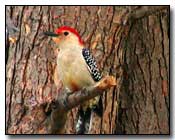 Usually
a bird will land on a perch for a few seconds before proceeding to the
bird feeder. It may be due to other birds eating at the moment or just
scouting the area to make sure that there are no predators nearby.
Whatever the reason, the perch gives you an opportunity for bird
photography. Before you decide on the placement of your bird feeder,
see if there are natural perches available or if there is an area that
you can create your own perch. The woodpecker is sitting on a perch
that was cut from a dead branch. If the whole dead branch had been
left, the bird probably would not stop there. Since it was cut short,
birds almost always stop on the perch. Usually
a bird will land on a perch for a few seconds before proceeding to the
bird feeder. It may be due to other birds eating at the moment or just
scouting the area to make sure that there are no predators nearby.
Whatever the reason, the perch gives you an opportunity for bird
photography. Before you decide on the placement of your bird feeder,
see if there are natural perches available or if there is an area that
you can create your own perch. The woodpecker is sitting on a perch
that was cut from a dead branch. If the whole dead branch had been
left, the bird probably would not stop there. Since it was cut short,
birds almost always stop on the perch.
Stacked Logs:
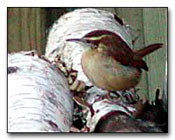 Stacks
of logs can also be used for a perch. In fact, a hole can be drilled
into a log and filled with seed. The seeds will attract birds to the
wood pile and a natural looking bird photograph will result. Experiment
with both light and dark logs based on the colors of the birds that
visit your yard. Remember that white colored logs may fool the camera
meter, but at the same time, might be a background that accentuates the
colors of a particular bird. You also might want to try turning the
logs either parallel or perpendicular to your camera. Stacks
of logs can also be used for a perch. In fact, a hole can be drilled
into a log and filled with seed. The seeds will attract birds to the
wood pile and a natural looking bird photograph will result. Experiment
with both light and dark logs based on the colors of the birds that
visit your yard. Remember that white colored logs may fool the camera
meter, but at the same time, might be a background that accentuates the
colors of a particular bird. You also might want to try turning the
logs either parallel or perpendicular to your camera.
Brush Pile:
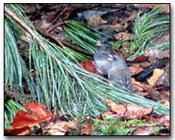 Broken
white pine branches piled on top of each other create another nice area
for birds to eat as well as seek shelter. The white pine branches will
also remain green for a very long period of time, especially in winter.
A good time to gather white pine branches is after a heavy winter snow
since many branches break due to the weight of the snow. Tossing seed
in front or on top of the pile of pine branches will create
opportunities for bird photographs. You can also stack dead piles of
branches but sometimes the dead branches will interfere with the bird's
legs when the bird is being photographed. Broken
white pine branches piled on top of each other create another nice area
for birds to eat as well as seek shelter. The white pine branches will
also remain green for a very long period of time, especially in winter.
A good time to gather white pine branches is after a heavy winter snow
since many branches break due to the weight of the snow. Tossing seed
in front or on top of the pile of pine branches will create
opportunities for bird photographs. You can also stack dead piles of
branches but sometimes the dead branches will interfere with the bird's
legs when the bird is being photographed.
Feeder Placement:
Based on the lighting, the background, the perch and the distance from
where you will photograph from, place your bird feeder in an area that
meets these requirements. You might also be fortunate enough to be able
to photograph from the inside of your house. The obvious advantage of
being able to photograph from within your house is that you will not be
seen by the birds too easily. Just remember any fast movement, whether
you're outside or inside, will frighten most birds. Don't forget to
purchase the correct bird seed for the birds in your area or all your
planning will be of no use.
Making Friends With The Squirrels:
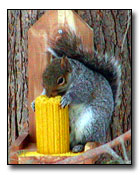 Whatever
steps you take to stop the squirrels from eating from your bird feeders
will not succeed. They are extremely smart and will figure out how to
eat from your bird feeders. The best way to solve the squirrel issue is
to place a squirrel feeder with corn-on-the-cob on a tree. One
compressed corn is equal to about 10-12 individual corns so they last
quite a while. If you don't find a sunny place for the squirrel feeder
in the morning or late afternoon, don't be too concerned. The squirrels
usually come around to eat during all times of the day as they are
constantly looking for food. If the squirrels learn to trust you, you
will be able to walk very close to photograph them. Whatever
steps you take to stop the squirrels from eating from your bird feeders
will not succeed. They are extremely smart and will figure out how to
eat from your bird feeders. The best way to solve the squirrel issue is
to place a squirrel feeder with corn-on-the-cob on a tree. One
compressed corn is equal to about 10-12 individual corns so they last
quite a while. If you don't find a sunny place for the squirrel feeder
in the morning or late afternoon, don't be too concerned. The squirrels
usually come around to eat during all times of the day as they are
constantly looking for food. If the squirrels learn to trust you, you
will be able to walk very close to photograph them.
In Summary:
Backyard photography is convenient as it brings
the subject to you. Once you recognize the patterns of the birds and
wildlife that visit your backyard, you will be rewarded with many
backyard photography opportunities.
About the Author:
Outdoor photographer and adventurer, Phil Tulin is the creator of Outdoor Eyes. The above article has been repreinted with permission from Phil and Mel's highly successful column 'Seeing With Outdoor Eyes'.
|

|
|
|
|
|
|
*****
Reader's Story *****
|
Back
to the Top |
|
|
|
GOOD HOUSEKEEPING
by Brian Taylor
Our home is situated on top of a flat
top hill, near the Great Dividing Range at the head of the Darling
Downs in Queensland Australia.
There is an abundance of nesting places
in the hollows of trees in the adjacent bushland. Water is not a
problem, as there are numerous stock watering troughs handy. In order
to provide some extra food for the birds that have struggled through
prolonged drought I have provided a feeding place for them. This
consists of a 2 metre long, hollow log with the circumference
of a football, which I had ripped lengthways with the chainsaw,
and had suspended from the rafter of the shade verandah, outside our
dining-room glass doors.
Birds who feel comfortable at this close
proximity, come to perch, warble, screech, or just strut and coo, as
do the top-knot pigeons.
Recently, pairs of Galahs, these
comedians of the bush, have decided to join the family and satisfy
their curiosity and join the feasting.
Continuous feeding has left, I imagine,
a build up of trash from seed husks in their feed trough.
A certain pair of Galahs, whom I
recognize by their ritualistic behaviour on alighting, had come to
inspect the day's feeding prospects. Having strutted the length,
swapped sides, with difficulty, then did the length inspection
in reverse, with much looking, nodding, ruffling of the neck and
crest feathers, they were away with a screech, and of into the
bushland.
This was such a performance I had to
Question my knowledge of bird behaviour ---“
What--- was that all about?” as we continued our meal.
Presently they returned. The male bird
had a sprig of narrow leaf iron bark in his beak, as big as the
span of my hand. “Now what’s he up to?”
I asked my wife.
With that he began in a most
business like manner, to sweep the feed trough clean of trash, from
one end to the other. The female stood at attention on one end
captivated by his thoroughness, as we both were.
Having satisfied himself that the job
was up to scratch, and completely happy with his housework, he
dropped his “broom” over the side, then looked all
about as one would to cross a busy roadway. He and the female
exchanged nods of good grace, and they commenced to feed on the
seeds left remaining.
Now here is the funny bit------, the
male bird does not just eat the seed and discard the husk. Having
eaten the seed, he stands on one leg, takes the husk from his mouth
with the other, and throws it over the side.
About the
Author:
Brian Taylor is an experienced
bushman, having worked as a stockman in outback Queensland for most of
his working life. In recent years he has authored
several books. Two of his bestsellers are 'The Brumby Mare' and
'The Moonlight
Stallion'.
|
|
Readers'
Stories: Would
you like to share a story about the birds in your backyard?
We
would love to hear from you. Please send us an e-mail at editor@wingedhearts.org
and remember to include your name, city and country.
|
|
|
|
|
*****
Coming In The Next Issue and News *****
|
Back
to the Top |
|
|
In The News:
Benny's
story - in Angel Animals: Linda and Allen
Anderson invited us to send Benny and Maggie's story for
their e-zine: Angel Animals
Story of the Week, 12-9-07. Click here for the story.
Chasing Eagles - on Spongefish: Social Media
site Spongefish
invited us to put our video on Chasing
Eagles on their site. You can
view it by clicking here and do give us a 'Thumbs Up'
when you are there.
Coming
In The Next Issue:
We are very excited to be able to bring our readers a collection of
articles and stories from around the world. The next issue features
contributions from:
- Part 1 of a new series of articles on Communicating with
Wild Birds.
- An exclusive: excerpt from Brian Taylor's best
selling book 'The
Brumby Mare' (now out of print).
- and there are always some more surprises in the
wings....
Would you like to submit an article or your bird story? We
would
love to hear from you. People from all over the world have
remarkable connections and
experiences with wild birds. One does not often hear of these
in
learned journals because they are anecdotal and not part of a proper
scientific study. Nevertheless, they are still true and show
how
rich and deeply wonderful creatures in the wild are and how open
they are to making friends and helping humans. We would love to
hear these stories and share them with others. Please drop us a
line at: editor@wingedhearts.org
Invite Your Friends: If you would like to inform your friends about WingedHearts.org and invite them to subscribe to the Wild Bird Talking E-zine click here.
Many Thanks To our Readers: Many thanks to our friends and readers from around the world
who have visited the site and sent us their comments. we are very
grateful for your support, interest and encouragement.
Blogs - Comments, Topics and Forums: Please let us know if there are any topics you would like us to raise
in our blogs and please feel free to discuss your ideas and opinions or
share you bird sightings and experiences, by adding a comment to our
blogs. If you would like us to create a forum on the site for readers to join
and discuss topics of interest to them, please let us know.
If enough readers are interested, we will be delighted to
create
a forum on the site.
|
|
|
|
|
*****
Pick Of The Crop *****
|
Back
to the Top |
|
|
A
Hummingbird in My House
The Story of
Squeak - Arnette Heidcamp
Book Review
- by Ron House
|
This is a delightful true story about how author
Arnette
Heidcamp
spotted a ruby-throated hummingbird in her yard one day, long after
all the hummers should have gone south for the winter. Fearing it
would die of cold or hunger, she encouraged it into her house and
gave it a home through winter.
Not having hummingbirds here where I live, I read
it purely
for
the joy of meeting Squeak, as she called her little guest. But there
are enough tips in the book to make it a practical help for anyone
else who needs to care for one of these beautiful little birds.
Details of food and feeders, and plants favoured by Squeak, make
very useful information.
It is not a gripping story in the sense of a great
Whodunit
with
a master plot, because it is fairly obvious from the start that we
are being told the history of a winter spent in the company of a
delightful creature until its safe release the following spring. But
what it lacks in plot, it makes up for in sheer interest (for any
animal lover) of admitting us all to Arnette's personal joy getting
to know and be known by Squeak.
Finally, mention must be made of the simply incredible
photographs. Printed on first rate gloss paper in full colour, the
absolutely stunning quality of the original photos is rendered in
complete fidelity. Want to see hummingbird wings frozen in
mid-flight? Want to see the expression in the eyes of a creature
smaller than some moths? It's all here.
Summary? I can't imagine anyone who delights in
the world of
nature failing to love this book.
To check the book out on Amazon: click here
|
|
About
the Reviewer:
|
Ron
House is
co-founder of WingedHearts.org, a strong believer in animal
consciousness and the importance of treating them
ethically with love and care. Ron lectures in computing at USQ
and
writes on ethics, philosophy and the Principle
of Goodness
|
|
|
|
|
|
|
|
Back
to the Top |
|
|
|
|
|
|
*****
Subscription *****
|
Back
to the Top |
|
|
Subscription
information:
If you received this message from wingedhearts.org, you are a current
subscriber. To ensure that you continue receiving
our
emails, please add us to your address book or safe list.
If you
received this message from a friend and would like to subscribe at no cost,
please click on the link below and enter details in the left hand menu
bar: http://www.wingedhearts.org
To unsubscribe use the link you received on subscribing or please send
a blank message to subscriptions@wingedhearts.org
with unsubscribe in the subject line.
Share this e-zine with a friend - forward them this e-mail.
|
|
|
|
|
Logo design by Mieke K
All Rights
Reserved. All contents of this e-mail and Ezine are Copyright
2008.
For private, noncommercial use only. Copies must be
unaltered.
Attribution must
prominently state the author's name and that the source of the work is wingedhearts.org |
Back
to the Top |
|
|
|
|
|
|
|
|
|